
Recognitions

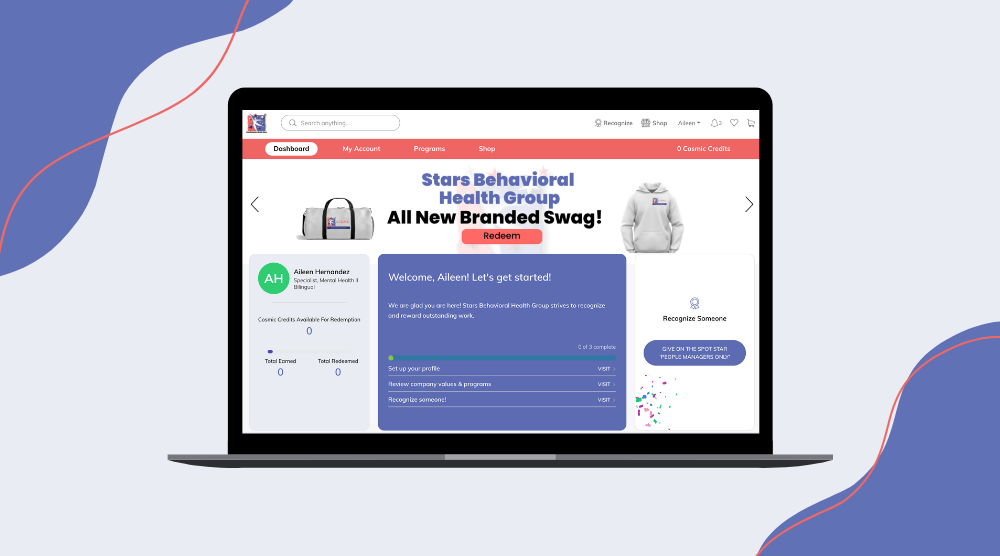

Branded Swag for Recognition: Why No-Minimum Merch Matters
Branded Swag for Recognition: Why No-Minimum Merch Matters
14:55
Branded Swag as a Recognition Reward: Why No-Minimum Merchandise Changes the Game for HR Teams
Branded company merchandise occupies a unique space in the employee recognition reward catalog. A gift card says 'we value your contribution enough to give you money to spend.' A branded item says something different: 'we value your contribution enough to give you something that connects you to this organization.' The hoodie, the insulated bottle, the quality notebook with the company name — these are objects that employees wear, use, and keep in ways that generic gifts don't produce, creating a lasting physical association between the recognition moment and organizational belonging.
Most HR leaders already understand this. The reason branded swag doesn't appear more often in recognition reward catalogs isn't that it isn't valued — it's that the logistics of making it available as a recognition reward are prohibitively burdensome under the standard model. Virtually every swag supplier and recognition platform that offers branded merchandise requires bulk minimum orders — typically 50 to 500 units per item. That minimum transforms branded recognition from a spontaneous, personal reward into a planned inventory management exercise that most HR teams can't sustain.
On-demand branded swag — merchandise ordered one item at a time, shipped directly to the employee, produced only when ordered — removes the logistics barrier entirely. This article covers why the minimum order requirement has historically limited swag as a recognition reward, the specific use cases that on-demand capability unlocks, and how Rewardian's no-minimum branded merchandise changes the economics and practicality of swag-based recognition.
The bulk minimum problem: why swag stays off the recognition menu
The standard swag procurement model works well for large, planned merchandise initiatives — conference giveaways, new hire kits ordered quarterly, branded uniforms. It works poorly for recognition programs, where the value of the reward depends on its connection to a specific moment and a specific person.
Consider what happens when an HR team wants to add branded merchandise to their recognition program under a bulk minimum model:
- They must estimate demand in advance — ordering enough units of each item to meet the minimum while not ordering so many that they end up with boxes of unsold branded jackets in the supply closet.
- They must select items for the whole population — choosing styles, items, and quantities that represent a reasonable choice for diverse employee preferences without the ability to let employees choose for themselves.
- They must manage size collection — for apparel, collecting size preferences across a potentially large and changing workforce before placing the order.
- They must handle distribution — for remote or distributed teams, shipping individual items to home addresses from an internal inventory, managing international shipping, and handling customs for global teams.
- They must time the purchase to the recognition calendar — the bulk order has to be placed weeks or months in advance, completely decoupling the swag from the spontaneous recognition moments it was intended to accompany.
The cumulative logistics burden makes branded swag impractical for most recognition programs — particularly for small teams, distributed workforces, and organizations that don't have a dedicated HR operations function. The result is that swag gets relegated to onboarding kits, annual service awards, and company-wide events — useful, but not the spontaneous recognition tool it could be.
|
Why the minimum order is the blocker The minimum order requirement is the single logistical barrier that prevents branded swag from being a recognition reward rather than a HR events item. Remove the minimum, and the use cases multiply: spontaneous peer recognition, remote onboarding, values-based milestone moments, sales incentive rewards. Every one of these requires the ability to order one item, not fifty. |
On-demand vs. bulk: a full comparison
The table below maps the seven most important dimensions of the branded swag logistics problem — contrasting the traditional bulk order model against Rewardian's on-demand no-minimum approach:
|
Dimension |
Traditional bulk swag model |
On-demand no-minimum model (Rewardian) |
|
Minimum order |
50–500 units per item — requires planning a bulk purchase event, storage, and distribution logistics |
1 unit — a single item for a single recognition moment, ordered at the point of recognition |
|
Lead time from recognition moment to delivery |
Weeks to months — the recognition moment is entirely decoupled from the reward delivery |
Days — the item ships directly to the employee at the time of recognition |
|
Who manages logistics |
HR or Office Manager coordinates ordering, warehousing, distribution, and size/preference collection |
The platform handles order, fulfillment, and direct-to-employee shipping — zero HR logistics overhead |
|
Works for remote/distributed teams |
Poorly — shipping to individual remote addresses requires collecting addresses, managing international shipping, and handling customs |
Yes — direct-to-employee shipping to any address, including remote and international locations |
|
Flexibility of recognition moment |
Constrained to scheduled swag events (onboarding kits, anniversary packs, end of year) — not suitable for spontaneous recognition |
Unlimited — any recognition moment can include a swag item; recognition can be spontaneous and personally selected |
|
Employee choice |
HR selects items in bulk; employees receive what's available, not necessarily what they'd choose |
Employee selects from a catalog of branded items; preferred size, style, and product type chosen at redemption |
|
Program waste |
Over-ordering (to avoid stockouts) creates inventory that goes unclaimed; under-ordering leaves some employees without items |
Zero over-ordering — items are produced on demand; no unsold inventory |
The employee choice dimension
One of the most underappreciated benefits of on-demand branded swag is that it makes employee choice genuinely possible. Under a bulk order model, HR selects items for the whole population — a practical necessity when ordering 200 units. The employee receives whatever is available, in whatever size HR estimated for them.
On-demand swag through a recognition platform lets the employee select from a catalog of branded items at the point of redemption: preferred item type, size, color variant where available. The recognition reward is both branded and personally chosen — which significantly increases its perceived value relative to a pre-selected HR gift.
The use cases that no-minimum swag unlocks
The practical value of on-demand branded swag is best understood through the specific recognition use cases that bulk minimums make impractical. The table below maps six use cases to why swag works there and why bulk minimums prevent it:
|
Recognition use case |
Why swag works here |
Why bulk minimum prevents it |
|
Spontaneous peer recognition of a great contribution |
A branded hoodie or quality notebook accompanying a specific, personal recognition message creates a tangible, lasting signal of appreciation with lasting organizational association |
The spontaneous moment can't wait for a bulk order cycle; HR can't stock branded items at all times for on-demand distribution |
|
Service milestone recognition (1-year, 3-year, 5-year) |
Branded items tied to specific tenure milestones create symbolic markers of career investment — a 5-year anniversary branded jacket is a fundamentally different signal from a generic gift card |
Milestone items are often ordered annually in bulk — but the timing rarely aligns exactly with the employee's anniversary date, and items are pre-selected by HR rather than chosen by the employee |
|
Remote employee onboarding recognition |
A branded welcome package shipped directly to a remote employee's home address creates a belonging signal that replaces the in-office first-day experience |
Bulk onboarding swag kits require collecting home addresses, managing international shipping, and ordering in batches — creating timing gaps and logistics overhead that erode the welcome signal |
|
Values-based recognition moment |
An employee recognized for demonstrating a specific company value receives a branded item with the value name on it — a lasting physical reminder of the acknowledgment and its cultural significance |
Per-item branded items referencing specific values require production flexibility that bulk orders don't support |
|
Small-team or startup recognition |
Smaller organizations can offer branded recognition rewards without the financial and logistical overhead of bulk ordering — making swag accessible as a recognition tool at any company size |
Bulk minimums are economically impractical for teams under 50 people and logistically burdensome for distributed small teams |
|
Sales incentive and performance reward |
Sales reps who hit specific milestones receive premium branded merchandise as a recognition reward alongside cash components — adding symbolic value and organizational association to commercial incentives |
Sales incentive timing is deal-driven, not calendar-driven; bulk order cycles can't anticipate individual rep achievement timelines |
The remote team use case: the most impactful unlock
The remote workforce recognition challenge is one of the most widely discussed engagement problems in post-pandemic HR — and branded swag is one of the most underused solutions because bulk minimum logistics make remote distribution impractical. An HR team with 80 remote employees distributed across 12 countries cannot practically manage a branded swag inventory, collect home addresses, process international shipping for individual items, and handle customs documentation for a multi-country distribution.
On-demand swag changes this completely. A remote employee recognized for a specific contribution receives a recognition message and a reward point credit that redeems for a branded item shipped directly to their home address. HR handles none of the logistics. The employee receives a physically tangible recognition reward — in their home, with their name on the order — that creates a belonging signal that no digital recognition alone can replicate.
|
What the physical object does that digital can't The branded item delivered to a remote employee's home address does something that a digital recognition message and a gift card can't: it places a physical object in their personal space that represents organizational investment and belonging. That's not a minor difference — for a remote employee who may go weeks without in-person interaction with colleagues, a quality branded item is a presence that the organization maintains in their environment. |
What to look for when evaluating swag in recognition platforms
When assessing branded merchandise capabilities in a recognition platform evaluation, the questions that reveal whether swag is a genuine feature or a checkbox:
- Is there a minimum order quantity for branded items? The answer should be 'no' for a platform claiming on-demand swag capability. Any minimum above 1 unit reintroduces the logistics barriers that make spontaneous swag recognition impractical.
- Does the employee choose their item, or does HR? Employee-choice redemption significantly increases perceived reward value and eliminates size and preference collection overhead for HR.
- What are the lead times for delivery? On-demand production adds some production time relative to shipping from an existing inventory. Typical on-demand lead times are 5–10 business days for standard items. Ask for specifics in your primary delivery markets.
- Can branded swag be shipped to international addresses? For distributed or global teams, international delivery capability — with transparent customs and shipping cost handling — determines whether swag is accessible to the whole workforce or just the domestic portion.
- What types of branded items are available? Quality apparel (not just promotional-grade t-shirts), lifestyle items (insulated drinkware, quality bags, notebooks), and tech accessories are the categories with the highest perceived value in recognition contexts. Ask to see the actual catalog, not a brochure.
The sustainability angle: on-demand reduces waste
Branded merchandise ordered in bulk produces a structural waste problem: over-ordering to avoid stockouts leaves inventory that goes unclaimed, often ending up discarded or stored indefinitely. For organizations with sustainability commitments, a bulk swag model is in direct tension with those commitments — and increasingly visible to employees who notice the disconnect between the company's sustainability messaging and boxes of branded water bottles gathering dust in the supply closet.
On-demand production eliminates this entirely. Items are produced only when ordered. There is no inventory, no over-ordering, and no unsold stock. For organizations with ESG commitments or environmental sustainability goals, on-demand branded merchandise is a structurally more responsible model than bulk procurement — which is itself a differentiating message for HR teams making the internal case for recognition program investment.
|
The sustainability case for on-demand swag On-demand swag produces zero unsold inventory. Bulk swag almost always produces some. For HR leaders building a recognition program business case for a sustainability-conscious leadership team, the production-on-demand model isn't just operationally superior — it's an ESG argument for why on-demand swag is the right choice rather than a bulk approach. |
|
Want to see how on-demand branded swag works in Rewardian's recognition platform? Rewardian includes no-minimum on-demand branded merchandise in its reward catalog — allowing individual branded recognition rewards for any employee, at any time, shipped directly to any address. We'll show you the catalog, the redemption flow, the delivery lead times, and how it integrates with recognition points to make swag a practical reward for spontaneous recognition moments rather than just planned HR events. If you want to make branded merchandise a real part of your recognition program without the logistics overhead, we'd love to show you how. |
Frequently asked questions
-
Yes — branded company merchandise is one of the most effective recognition rewards available because it combines tangible value with organizational belonging signal. The primary practical barrier has historically been minimum order quantities (typically 50–500 units) that make spontaneous, individual branded rewards logistically impractical for most HR teams. On-demand branded merchandise platforms with no minimum order quantities remove this barrier, enabling single-item branded rewards for individual recognition moments — shipped directly to the employee, in their choice of item type and size.
-
Most recognition platforms either don't offer branded merchandise, or require bulk minimum orders that limit its use to planned HR events rather than spontaneous recognition. Rewardian offers on-demand branded merchandise as part of its recognition reward catalog with no minimum order quantities — meaning a single branded item can be ordered for a single employee at the point of recognition and shipped directly to their address. This makes branded swag viable for spontaneous recognition, remote employee rewards, milestone acknowledgment, and sales incentive moments that can't wait for a bulk order cycle.
-
In Rewardian's on-demand swag model, branded merchandise is available in the employee reward catalog alongside gift cards, experiences, and other reward types. When an employee earns enough recognition points to redeem a branded item, they select from the available catalog of company-branded products, choose their size and preference where options are available, and enter their delivery address. The item is produced on demand and shipped directly to the employee — typically within 5–10 business days. HR manages the brand assets and approves item types; the platform handles all production, fulfillment, and shipping logistics without HR involvement in individual orders.
-
Per-unit cost for on-demand produced items is typically higher than bulk-order unit cost at equivalent quantities. However, the total cost comparison should account for the waste reduction (no unsold inventory), the HR logistics cost elimination (no ordering, warehousing, distribution, or size collection overhead), and the higher perceived value of employee-choice items relative to HR-selected bulk gifts. For most mid-market recognition programs, the total cost advantage of on-demand swag — including time savings, waste reduction, and higher reward impact — outweighs the per-unit price premium.
Barry Gallagher
Barry is Head of Content Strategy at Rewardian, where he covers employee recognition program design, sales incentive strategy, and HR technology. He has spent eight years working with mid-market HR and sales operations teams on recognition and incentive program architecture.